A city of Mauretania
The city grows in a fertile agricultural plain near Jebel Zerhoun.
Volubilis (وليلي, Oualili) is an archaeological site in Morocco, near Moulay Idriss Zerhoun and Meknès. At the foot of Jebel Zerhoun, it brings together the traces of several civilizations.
Volubilis (وليلي, Oualili) is an archaeological site in Morocco, near Moulay Idriss Zerhoun and Meknès. At the foot of Jebel Zerhoun, it brings together the traces of several civilizations. Its streets, public monuments and richly decorated homes reveal the life of an ancient city in a remarkable natural setting.
 STONE HOLDS THE MEMORY.
The city grows in a fertile agricultural plain near Jebel Zerhoun.
Streets, public buildings and mosaic houses reveal urban life and olive-oil production.
The story continues after the Roman period and intersects with that of Idris I.
The site joins the UNESCO World Heritage List.
Volubilis was more than a Roman town: it was Mauretanian before Rome, remained inhabited after the imperial administration left, and witnessed the birth of Morocco’s first Muslim dynasty.
Punic inscriptions and the earliest urban levels show an important town of the kingdom of Mauretania. Under Juba II, an ally of Rome, it prospered; the idea that it served as a royal residence is still debated.
After Caligula had King Ptolemy killed, a revolt broke out. Volubilis stayed loyal to Rome and Emperor Claudius granted it municipal status and Roman citizenship for its inhabitants.
Under Marcus Aurelius the town was enclosed by a wall more than 2.5 km long. Estimates suggest up to 20,000 inhabitants, and dozens of presses show how important olive oil was.
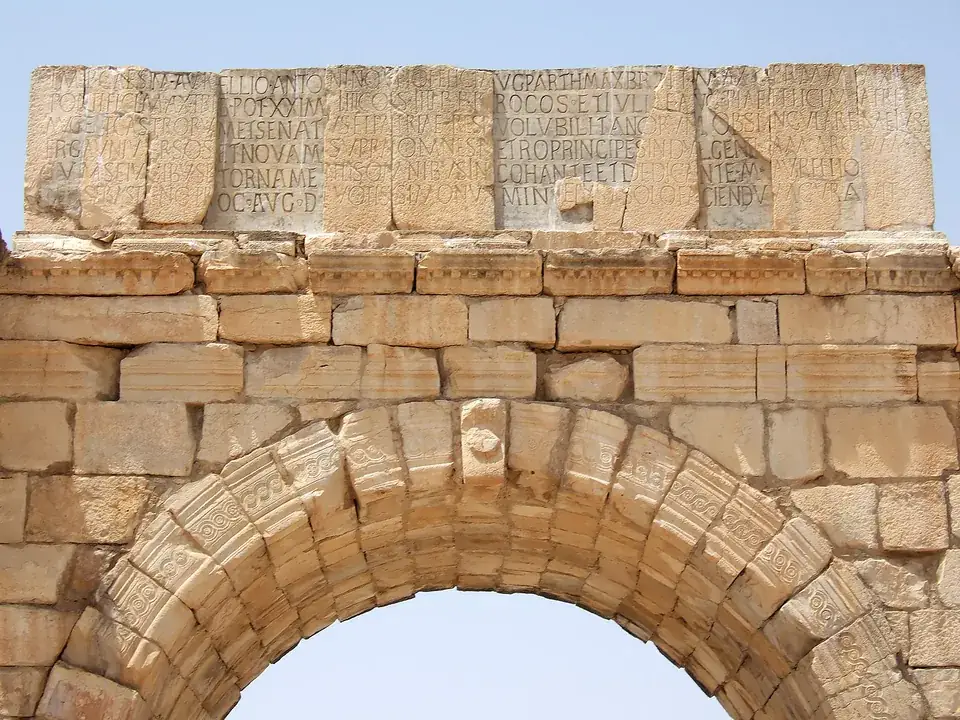
Governor Marcus Aurelius Sebastenus had the arch built in honour of Emperor Caracalla and his mother Julia Domna. The forum, basilica and Capitol belong to the same great building phase.
The Roman administration pulled back to the north of the province. The town was not deserted: a Latin-speaking population remained, and Latin inscriptions were still carved there in the 7th century.
Idris I, a descendant of the Prophet, was welcomed by the Awraba tribe and proclaimed imam, founding the Idrisid dynasty. His shrine stands nearby in Moulay Idriss Zerhoun.
Power moved to Fez and the town slowly emptied. In the 18th century stones were reused for Moulay Ismail’s building works in Meknes, and the 1755 earthquake caused further damage.
Archaeological excavations began in 1915. The arch and several columns were restored in the 20th century, and a large part of the ancient town has yet to be explored.
The most famous mosaics are still in place, in the houses where they were laid. They decorated reception rooms and reveal the tastes of the town’s wealthy families.
In the southern quarter, a large residence whose mosaic shows Orpheus charming the animals with his lyre; other rooms keep dolphins and a marine scene.
Near the main street, a mosaic gathers the hero’s labours in medallions. It is one of the easiest scenes to recognise on the site.
Its floors show Hylas carried off by the nymphs and Diana surprised while bathing, among the finest compositions in Volubilis.
Named after a bronze statue of an ivy-crowned youth found here, now kept in the national collections in Rabat.
Some houses may be closed or protected during conservation work. Stay on the paths and never walk on the mosaics.
Follow the ancient streets and let the details tell the story.
A striking landmark that opens onto the landscape and the ancient city’s main thoroughfare.
Mythological scenes and intricate patterns reveal the artistry of the city’s ancient homes.
Around the forum, the basilica and the Capitol evoke the public life of the ancient city.
Plan transport to Volubilis, arrange your return and compare direct travel with a multi-stop day from Fes or Meknes.
How to get to Volubilis from Meknes or Fes ↗Understand the main remains by distinguishing public buildings, houses and domestic decoration.
What to see at Volubilis: mosaics, arch and Roman monuments ↗Plan a flexible walk through Volubilis, prioritise the main sights and adapt your route to your group and the areas open that day.
Visiting Volubilis: a flexible route for your first visit ↗